

 Sophie Turner
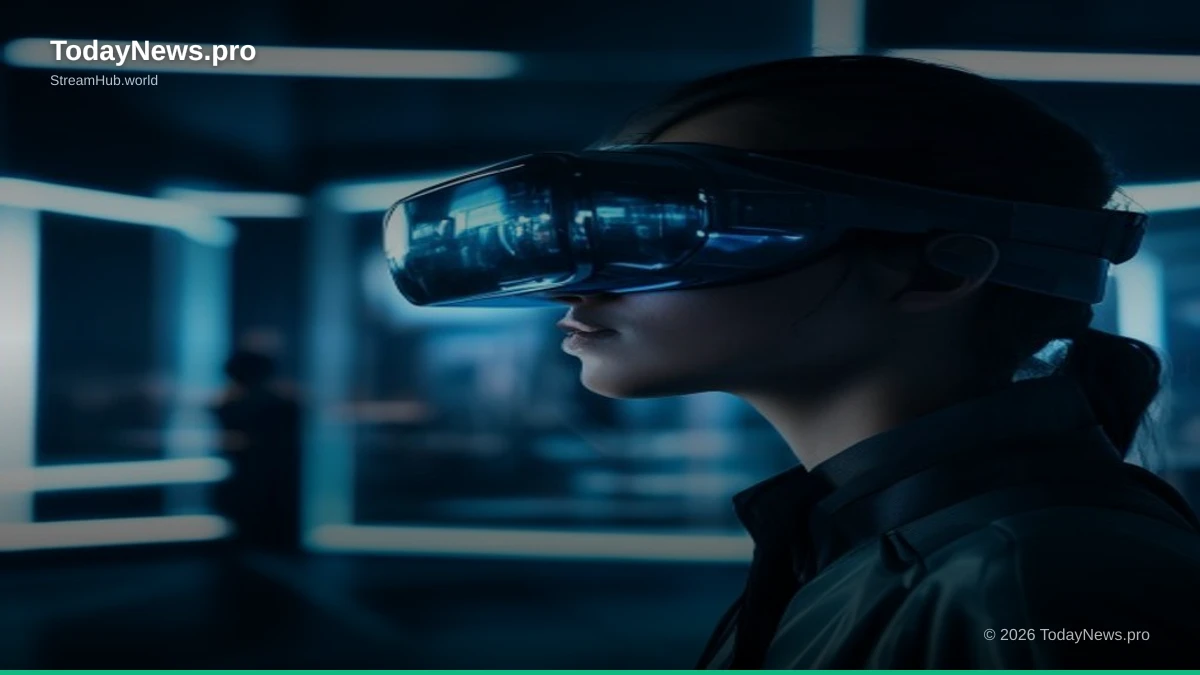
The global virtual reality (VR) and augmented reality (AR) market is projected to reach $576.73 billion by 2027, indicating a monumental shift in how we interact with digital content and the world around us.
The Dawn of Immersive Realities
For decades, our engagement with digital media has been largely confined to two-dimensional screens. From flickering television sets to high-definition monitors, the window to the digital world has remained flat, offering a passive experience. However, the advent of Virtual Reality (VR) and Augmented Reality (AR) is rapidly dismantling these limitations, ushering in an era of profound immersion that is fundamentally reshaping entertainment, education, and even our professional lives.
VR, by its very nature, aims to transport users to entirely simulated environments. Donning a headset, one is no longer an observer but a participant, fully enveloped in a digital world. AR, conversely, overlays digital information and graphics onto the real world, enhancing our perception and interaction with our physical surroundings. Together, these technologies represent a paradigm shift, moving us from simply viewing content to actively experiencing it.
The Technological Underpinnings
The rapid evolution of VR and AR is fueled by a confluence of technological advancements. High-resolution displays, powerful mobile processors, sophisticated motion tracking, and increasingly affordable hardware have brought these once-futuristic concepts within reach of the mainstream consumer. The development of haptic feedback suits and advanced spatial audio further deepens the sense of presence and realism.
The underlying infrastructure, including faster internet speeds and cloud computing, is also crucial. Streaming high-fidelity VR content and processing complex AR overlays demands significant bandwidth and processing power. As these technologies mature, the distinction between the digital and physical realms begins to blur, opening up a universe of possibilities.
Entertainments New Frontier: Beyond Passive Viewing
The entertainment industry, perpetually seeking novel ways to captivate audiences, has been an early and enthusiastic adopter of AR and VR. Gone are the days when entertainment was solely about watching a movie or listening to music. Now, audiences can step *into* the narrative, becoming active participants in stories and experiences.
Immersive storytelling is no longer a niche concept. VR films allow viewers to explore the scene, choose their perspective, and even influence the plot to a degree. Imagine being present at a live concert, not just in the front row, but on stage with the performers, or experiencing the thrill of a roller coaster from multiple dynamic viewpoints. This level of engagement fosters a far deeper emotional connection and memorable experience than traditional media can offer.
Interactive Narratives and Live Events
The potential for interactive narratives is vast. VR experiences can range from chilling horror scenarios where the player must navigate a haunted house, to epic adventure games where they wield magical powers. AR enhances live events by providing real-time information, interactive elements, or even virtual characters that interact with the physical stage. Concertgoers might see virtual visualizations erupting around the band, or sports fans could access player statistics overlaid onto the field of play.
The democratization of content creation is also a significant factor. As VR/AR development tools become more accessible, independent creators can produce compelling immersive experiences, leading to a diverse and vibrant ecosystem of new entertainment formats. This shift promises to move entertainment from a consumer-based model to a participant-based one.
Gamings Quantum Leap
Gaming, perhaps the most obvious beneficiary of VR and AR, is experiencing a revolution. The immersive nature of these technologies transforms video games from a digital pastime into a visceral, all-encompassing adventure. The line between the player and the avatar blurs, leading to an unprecedented level of engagement and realism.
VR gaming offers a level of immersion that traditional gaming cannot match. Players can physically duck behind cover, swing swords, or pilot spacecraft, their real-world movements directly translating into in-game actions. This physicality adds a new dimension of challenge and excitement, appealing to both seasoned gamers and newcomers alike.
The Rise of Immersive Play
AR gaming, exemplified by phenomena like Pokémon GO, seamlessly blends the digital and physical worlds. Players can chase virtual creatures in their own neighborhoods, turning everyday environments into interactive playgrounds. The social aspect of AR gaming is also significant, encouraging players to explore their surroundings and interact with others in shared virtual spaces overlaid onto reality.
The genres benefiting most are often those that rely on spatial awareness and physical interaction. First-person shooters become intensely realistic, racing games offer the sensation of being in the driver's seat, and puzzle games can leverage the entirety of a player's physical space. The development of more advanced haptic feedback and full-body tracking promises to make virtual worlds even more tangible.
| VR Game Genre | Average User Engagement (Hours/Week) | AR Game Genre | Average User Engagement (Hours/Week) |
|---|---|---|---|
| Action/Adventure | 7.8 | Location-Based Exploration | 6.5 |
| Simulation | 9.2 | Puzzle/Strategy | 5.1 |
| Rhythm/Music | 8.5 | Augmented Pet/Collection | 7.2 |
Virtual Tourism and Experiential Travel
The dream of visiting distant lands or exploring historical sites has long been a staple of human aspiration. VR and AR are now making these dreams more accessible than ever, offering virtual tourism and experiential travel that can supplement or even inspire real-world journeys. For those unable to travel due to physical limitations, cost, or time constraints, these technologies offer a remarkable alternative.
Virtual tourism allows users to explore renowned landmarks, walk through bustling city streets, or marvel at natural wonders from the comfort of their homes. Imagine standing on the Great Wall of China, exploring the ruins of Machu Picchu, or diving in the Great Barrier Reef, all through a VR headset. This immersive experience goes beyond static images and videos, providing a sense of presence and scale that is truly compelling.
Augmented Exploration
AR enhances the travel experience in the real world. Tourists can point their phones at historical buildings to see them recreated in their prime, access interactive maps that highlight points of interest, or even have virtual guides explain the significance of landmarks. This overlay of digital information enriches the understanding and appreciation of a destination.
Beyond tourism, VR and AR are being used to create virtual replicas of entire cities or historical periods. These can serve as educational tools, allowing students to “visit” ancient Rome or explore the Amazon rainforest without leaving their classroom. The potential to democratize access to cultural heritage and natural wonders is immense.
Education Reimagined: Learning by Doing
The traditional classroom model, often reliant on textbooks and lectures, can struggle to engage all learning styles. VR and AR are emerging as powerful pedagogical tools, transforming abstract concepts into tangible, interactive experiences that foster deeper understanding and retention.
In VR, students can dissect a virtual frog without any ethical concerns, explore the human circulatory system from within, or walk on the surface of Mars. This "learning by doing" approach, facilitated by immersive simulations, allows for safe experimentation and exploration of complex subjects. Medical students can practice intricate surgical procedures in a risk-free environment, while history students can witness pivotal moments in time firsthand.
Interactive Learning Modules
AR applications in education can bring textbooks to life. Pointing a device at an image of the solar system might reveal a 3D, rotating model of the planets that students can interact with. Anatomy lessons can involve overlaying virtual organs onto a 3D model of the human body, allowing for detailed examination. This multi-sensory approach caters to kinesthetic and visual learners, making education more dynamic and engaging.
The ability to personalize learning experiences is another significant advantage. VR and AR platforms can adapt to individual student paces and learning styles, providing tailored feedback and reinforcement. This has the potential to address learning gaps more effectively and empower students to take greater ownership of their educational journey.
For more information on the educational applications of AR/VR, see Wikipedia's entry on the subject.
The Future of Work and Collaboration
Beyond entertainment and education, AR and VR are poised to revolutionize the workplace, enhancing collaboration, training, and remote operations. The ability to create shared virtual spaces where colleagues can interact, regardless of their physical location, is a game-changer for distributed teams.
Virtual meeting rooms can offer a sense of presence akin to in-person gatherings, complete with spatial audio and the ability to interact with shared 3D models or whiteboards. This can foster better communication and teamwork, reducing the isolation often associated with remote work. Imagine architects collaborating on a building design in a shared VR space, able to walk through the virtual structure together and make real-time adjustments.
Immersive Training and Design
Industrial training is a particularly strong use case. VR simulations can train employees on complex machinery, hazardous environments, or intricate assembly processes without any real-world risk. This leads to more effective training, reduced accidents, and lower operational costs. AR can provide real-time guidance for maintenance technicians, overlaying instructions and schematics directly onto the equipment they are servicing.
Product design and prototyping are also benefiting. Engineers and designers can create and iterate on 3D models in VR, visualizing products at full scale before any physical prototypes are built. This accelerates the design process, reduces material waste, and allows for more intuitive feedback loops. The integration of AR into design reviews can also provide stakeholders with a more tangible understanding of proposed designs.
Learn more about the business applications of AR/VR from Reuters.
Challenges and the Road Ahead
Despite the immense potential, the widespread adoption of AR and VR faces several hurdles. Hardware costs, while decreasing, can still be a barrier for many consumers and businesses. The development of compelling content remains crucial; while more experiences are emerging, a critical mass of high-quality, diverse applications is needed to sustain momentum.
Issues of motion sickness and user comfort, particularly with VR headsets, need continued attention and technological refinement. Furthermore, the ethical implications surrounding data privacy, digital identity, and the potential for addiction or escapism require careful consideration as these technologies become more integrated into our lives.
Technological and Societal Hurdles
The development of robust, user-friendly interfaces and intuitive interaction models is ongoing. Achieving true photorealism in VR and seamless integration of AR into everyday life requires significant advancements in graphics processing, artificial intelligence, and sensor technology. The creation of open standards and interoperability between different platforms will also be vital for fostering a healthy ecosystem.
The societal impact of increasingly immersive digital realities warrants ongoing discussion. As VR and AR become more sophisticated, questions about the nature of reality, social interaction, and the potential for digital divides will become increasingly important. Responsible development and thoughtful implementation will be key to harnessing the transformative power of these technologies for the benefit of all.